
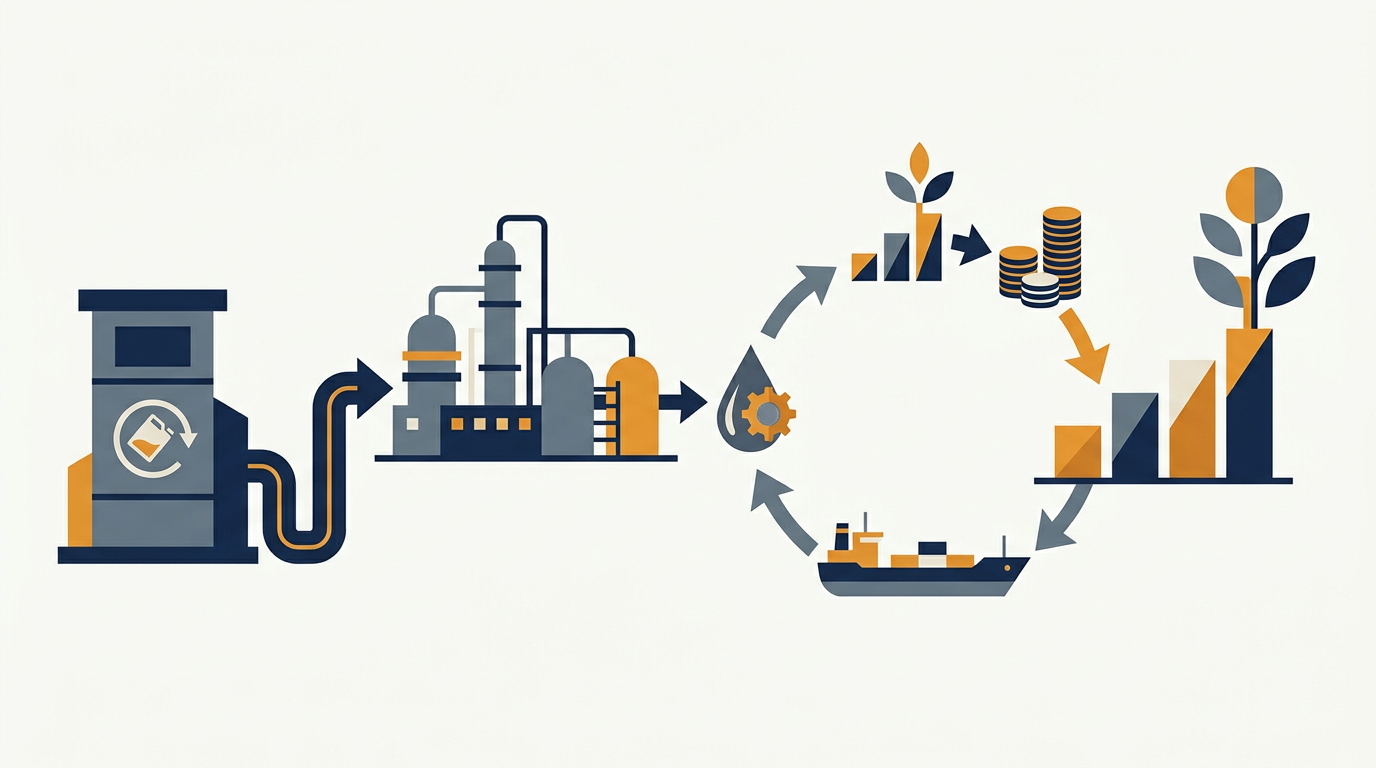
The International Business Times UK reports that Alkagesta is positioning itself at the forefront of the UK's drive towards net zero by focusing on waste-derived biofuels. The company views used cooking oil, once a byproduct, as a crucial raw material for the renewable fuel industry, aiming to redefine how global investors engage with the circular economy.
The UK's Renewable Transport Fuel Obligation (RTFO) mandates fuel suppliers to incorporate low-carbon biofuels. Data from the Department for Transport indicates that 3.7 billion litres of renewable fuel were supplied in 2023, a 10% increase from the previous year. Waste-derived inputs like used cooking oil and animal fats contributed significantly to this growth, benefiting from double crediting under RTFO rules.
Alkagesta, with its headquarters in Malta and strategic reach through Alkagesta Singapore, integrates commodity trading, logistics, and structured finance. This approach aims to make circular-economy assets bankable by aggregating used cooking oil supply, structuring long-term off-take agreements, and ensuring ISCC EU certification across its network.
Orkhan Rustamov, Alkagesta's Chief Executive Officer, stated that the company's customers value trust and transparency. He highlighted the opening of a Singapore hub as a strategic bridge between Europe and Asia, facilitating compliant fuel flows and contributing to a sustainable global trading ecosystem.
The company's London office focuses on institutional partnerships, utilising the UK's financial infrastructure to finance bio-feedstock projects across Europe, Asia, and Africa. Alkagesta Malta manages global sourcing and logistics, while Alkagesta Singapore serves as an operational hub for sourcing sustainable feedstocks and connecting regional producers to global buyers.
According to Alkagesta's 2024 ESG Report, the volume of used cooking oil collected and treated at its recycling plants increased by 10% year-on-year, with a 39% growth in collection points worldwide. The firm's feedstock processing plants now deliver bio-feedstock compliant with EU Renewable Energy Directive (RED III) standards.
London's role as a global hub for commodity trading and structured finance is crucial for scaling the circular economy. The International Business Times UK noted that UK-based ESG-related private equity transactions reached £71 billion in the first half of 2025, nearly doubling year-on-year, indicating strong investor interest in tangible assets with verifiable impact.